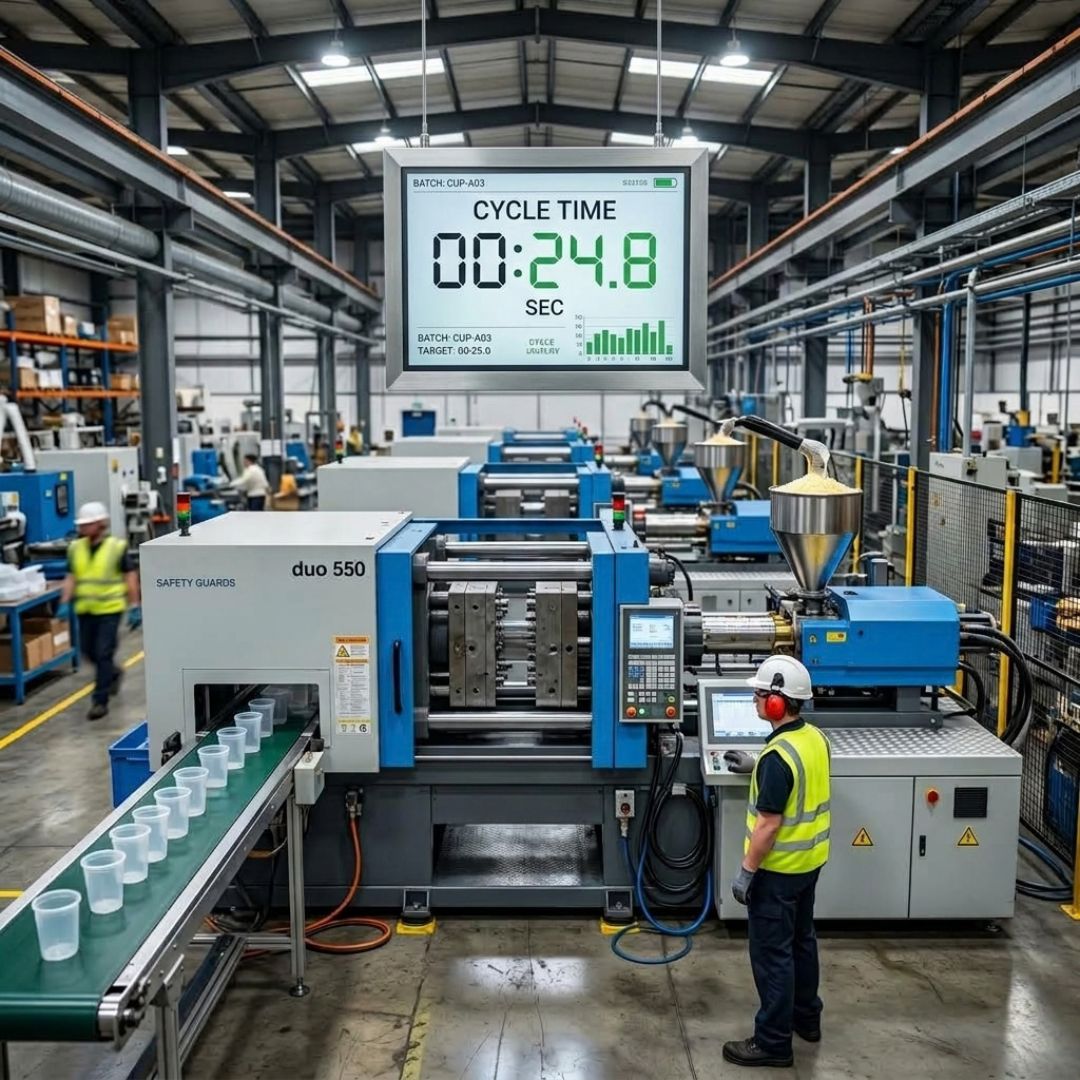
Cycle time is one of the most critical variables in pricing mass-produced plastic products. A skilled manufacturing partner knows how to minimize it to reduce costs, but uncontrolled, aggressive cycle reduction can lead to severe quality failures. Our experts explain how smart engineering design, advanced technologies, and early developmental involvement are the keys to achieving a competitive cost without compromising product quality
In the world of plastic manufacturing, the equation is simple and unforgiving: time is money. When producing tens or hundreds of thousands of units, every single second shaved off the cycle time (the duration required for the injection machine to complete one full sequence – from mold closing, through material injection and cooling, to part ejection) translates into massive economic savings and a highly competitive final product cost.
However, the “faster is always better” mindset is fundamentally flawed. Managing cycle time is a technological art form that demands a manufacturing partner with deep engineering expertise – one capable of striking the perfect balance between cost-efficiency and uncompromising quality.
The Perils of Speed: What Happens When You Cut Cycle Time Too Aggressively?
The temptation to speed up the machines is immense, but without meticulous planning, aggressively shortening the cycle time will directly damage your product. The longest and most critical phase of the cycle is the cooling stage. If the molten polymer isn’t given the required time to properly solidify within the mold, the results can be disastrous:
- Uneven Cooling and Warpage: When a part is ejected while it is still too hot, temperature differentials cause the material to shrink unevenly. This results in geometric distortion (warping) and compromises the part’s functionality.
- Internal Stresses and Mechanical Failure: Cooling too rapidly or ejecting prematurely traps latent internal stresses within the part. Under load, these stresses can lead to fractures, cracks, or complete structural failure.
- Cosmetic Defects: Over-shortening the cycle can trigger sink marks, flow lines, or surface blemishes that render the product aesthetically unacceptable.
Ultimately, high scrap rates caused by these quality issues will cost far more than the fractions of a second saved on the production line.
The Variables Dictating Cycle Time
Cycle time is not a random number; it is a derivative of physics and engineering. Among other factors, it is dictated by the raw material (different polymers require different injection and cooling temperatures), the wall thickness of the part (thicker walls require exponentially longer cooling times), the mold temperature, and of course, the efficiency of the cooling system integrated within the mold itself.
The Engineering Advantage: How Rion Beats the Clock
Achieving a rapid cycle time without risking the product requires holistic technological expertise. At Rion, we have developed comprehensive methodologies designed to optimize processes and responsibly reduce cycle times:
- Smart and Precise Mold Design: Rion’s engineering team leverages advanced Moldflow analysis to optimally design runner and cooling systems. Designing Conformal Cooling channels that closely track the complex geometry of the product ensures rapid, uniform heat dissipation, allowing for earlier and safer part ejection.
- Multi-Component (2K) Injection: When a product requires the integration of two different materials (for example, a rigid plastic body and a soft elastomer for sealing), Rion utilizes two-shot (2K) injection molding on a single mold. This technology eliminates the need for two separate production cycles and bypasses manual assembly, dramatically slashing the overall manufacturing time of the finished product.
- Production Process Optimization: Meticulously calibrating the machine’s injection parameters, from holding pressures to ejection speeds utilizing automation and robotics, shaves precious seconds off every cycle while guaranteeing high repeatability.
Why Timing is Everything: The Critical Role of Early Involvement
The biggest secret to achieving a competitive production cost isn’t found on the shop floor, but at the drawing board. One of the most common mistakes companies and entrepreneurs make is bringing a “locked” design to their manufacturer.
To maximize cycle time savings, it is critical to engage Rion’s engineering team as early as possible in the product design phase, a practice known as Early Supplier Involvement (ESI).
When Rion’s engineers review a product during the concept or Design for Manufacturing (DFM) phase, they can suggest minor geometric tweaks that dramatically impact production. For instance: reducing wall thickness in non-critical areas, adding structural ribs instead of bulky plastic mass, or optimizing draft angles. This early intervention facilitates the design of a simpler, faster mold, prevents heat traps within the part, and ensures absolute minimal cycle times, ultimately leading to a significant reduction in the final product cost.
Looking for a technological partner who can turn your product design into an engine of profitability?
With decades of experience, advanced engineering capabilities, and a holistic systemic approach, Rion is the manufacturing partner that will drive your product across the finish line – rapidly, with uncompromising quality, and at the most cost-effective price point.